Sunday, 20 February 2011

Across the Bolivian Salt Lakes and Desert to Chile


I took an overnight bus from La Paz to Uyuni. Once out of La Paz there are no roads as such through the desert so it was a bumpy ride but I managed to sleep almost all the way. Apparently the bus stopped several times. I was grateful I took the tourist bus and not the cheaper local bus which had an accident on route and was unable to continue its journey!

Uyuni is a tourist town in the middle of nowhere and does not have much going for it but it is a place where you can start a three day trip in a jeep across the salt lakes and desert to the Chilean border. Myself and a couple from South Africa who I had met on the Dragoman trip had booked the trip in La Paz but when we got to Uyuni we were told we had to pay more due to increases in fuel prices. Fuel in Bolivia had been kept at a low price but the Bolivian government had just realised that people were selling fuel at the Peruvian border for double the price so they had doubled the price overnight. As you can imagine there was uproar regarding this and as we left Uyuni the rest of the country was about to come to a standstill with road blockages and protests. It was pretty bad and went on for ages until the government reversed its decision! Lucky we got to Uyuni when we did, had we have been a day later we would have been in trouble. We were also asked to pay a fee for our passports to be stamped which I was told was not normal but hell were any of us going to argue with the border control guys. It was not much and clearly it was going straight into their pockets but hey, that´s Bolivia and is to be expected.

Initially it was a hot ride under a relentless sun and a dusty landscape, stopping at various points to take photo´s such as the redundant train lines, an island of Cacti, the amazing salt lakes and a disused salt hotel!. The tour included very basic accomodation and food which our driver cooked on route.
The 2nd part of the journey took us high up over volcanoes and mountains passing some amazing scenery including lakes with grazing flamingos, the famous landscape painted by Salvador Dahli, Thermal springs and geysers. The 2nd night was just a bed to lay your head, no running water atall....thank god for baby wipes and hand sanitizer! Outide of the building the wind was incredible and it was so cold, we were now back in hats, scarves and gloves. The stars however were phenomenal this far away from any other civilization! During the journey we visited and stayed at a few villages. Dont ask me how the few people that live out there in that harsh environment, maybe that is why they seemed less friendly.
In my opinion Bolivia is unique, the people are ´tough´ but I guess they have to be. Tourism is carried out but not all that well sometimes but when you think about it, in the first world you can do a degree in tourism but many Bolivians do not have much of an education atall, let alone the option to specialise in looking after the gringo´s! And why should they care, they are just trying to make ends meet and feed their families! Many gringo´s fall in love with Bolivia none the less and probably for these reasons.

Monday, 14 February 2011

La Paz (highest capital city in the world at 3600m)


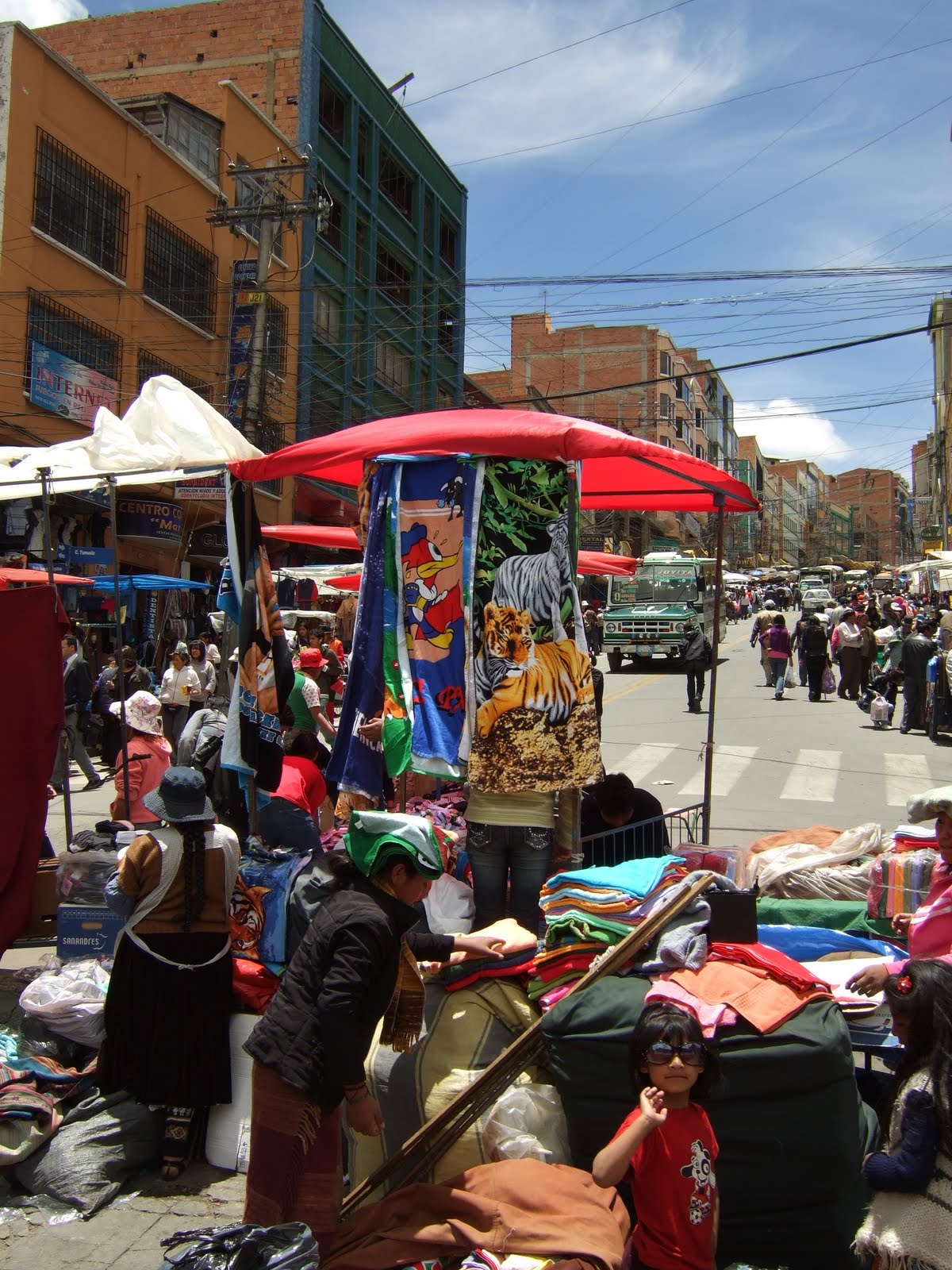
We arrived in La Paz on 22nd December, a big city with it´s 2 million inhabitants bustling with street markets, loads of people christmas shopping and heavy traffic with cars bumper to bumper burning out clutches on steep hills! Apparently cars suffer a 40% loss of energy due to the altitude and electrical items are known to break easily. (Bryn, I do not think it would suit you here). To be honest it all was a little scarey at first as personal security was of pririty and the place was heaving and confusing! The most under-developed South American country, the water is not safe for us Gringo´s to drink and even though I did not consume it I did pick something up in Bolivia (but more about that later!)
Not long after we arrived we were all bussed out for a city tour and a visit to the Luna Valley. Our guide was very interesting and seemed to want to air his views on the state of the Bolivian government, the corruption etc. Bolivia has the worst economy in South America and Evo Morales is the first indigeonous man to become president and has been in post since January 2006. At the centre of South America most countries have to import and export through it´s borders.
The average Bolivian salary is equivalent to 100US Dollars per month....to feed a family? (I think not). Hence there exists a massive black market which keeps things moving it would appear. Legally an Iphone costs 1000US Dollars (about 750 GBP) but our guide thinks there are loads of people with them!
Currently the main export is cocaine and the government allows farmers to grow as much coca as they want. As the president is also the leader of the coca farms, he cannot vote against them! Lithium could be a very important emerging industry if the country can secure it. 500 children are sold every year for between 200-300 US Dollars each!
None the less the city has it´s charms and those did grow on me! It´s intensity and mixture of traditonal and modern I found intriguing. The way it´s cogs continue to turn despite corruption etc. Despite the pollution, the streets are cleaned every morning and trading can be seen anytime of the night and day. The Bolivians are tougher than Peruvians and do not barter so easily which I admired. The centre sits in a bowl and the city spreads outwards and upwards through the surrounding mountains. There is little room for green space and roundabouts seem to be places to hang out, although you risk your life as you fight your way through cars, buses, pedestrians and street vendors. It really is hilarious.

Moon Valley
10km for La Paz, the moon valley is a natural work of art. The mountain of sandstone and clay has eroded to create a desert of stalagmites where the brief but heavy rains cause the clay to collapse but the surface bakes so quickly in the following heat of the sun which I can confirm is very hot, although night temperatures plumet!

An Orphonage
With some money left over from the kitty we all decided to donate it to an orphonage. One of the Dragoman had volunteerd for an orphonage in La Paz 6 years previously so she paid them a visit and it was agreed we would by the children much needed underwear and other items.
So we took ourselves off through the heaving street markets, pressed up against everyone for what seemed like hours to trade for these items! Wow, what an experience, one that I wouldn´t want to repeat in a hurry. In my flusstered state I learnt a valuable lesson - do not use an ATM when you dont feel composed! I lost my card (to the machine I think)!
We all then marched through the city streets in a long line wearing santa hats and carrying presents to the 40 -45 children. Both the staff and children were very greatful. Either Spanish or Aymara were the first languages for the children but some had been learning english and took the opportunity to practice this. Unfortunately there are no photo´s of the children for their protection.

Christmas
On the eve of Christmas the Dragoman crew all shared a buffet dinner at the hotel with a little informal dancing and lot´s of drink. We had christmas dinner at the local irish pub of course! Most of the other overlanding groups (following similar routes to get to Rio Carnival in March)were in the same pub so there was a jolly lot of Brits, Ozzies, Australians and banter. The rum shots were absolutley huge! I pinched myself several times as it was hard to believe I was not in England at Christmas! I was up late with friends drinking and discussing my long and drawn out decision to stay on with Dragoman or go Solo!!!

Final Decision at the Final Hour!
It was a difficult and bold decision to make but at 6.30am I finally said goodbye, knowing in my heart our paths would cross again somewhere in South America! I was a little upset because I had spent the last 5 and a half weeks with the same people but I felt it was important to experience some travelling on my own and although I was a little concerned I felt ready to put myself to the test.

Lake Titicaca


Leaving Cusco and heading towards Lake Titicaca we were ahead of the other Dragoman truck for a change, that is until we broke down! I cant remember what the reason was now but it was fixed easily and we were on our way again.
On route we stopped off at Sillustani Ruins but it was windy and raining so I didn´t feel that inspired. A girl asked for money because we took a picture of her Llama which was a first, up until now you only paid for people photo´s!
The landscape had become much flatter but we were infact at a higher altitude than Cusco. We stopped overnight at Puno (3800m). The next day we visited the communities living on floating islands made of reeds on the Lake Titicaca, the highest navigable lake in the world and a wopping 270m at it´s deepest part. This was very tourist, smelly and again the people were a bit pushy / hard selling. Maybe I was getting tired of this but it did seem a level above anything we had witnessed before!
A few hours drive on from Puno we reached the Bolivian border and I saw the first wheelbarrow! I know it sounds strange that I should notice such trivial things but up until this point I had seen lots of carrying vessels and wondered why wheelbarrows were not used.
The border crossing was not too complicated and on the Bolivian side of the lake I noticed that it looked less littered and there were noticebly more trees (which I was glad to see).
We stopped overnight at a nice little town on the lakeside called Copacabana. The next day we took a boat across to Isla del Sol where there is evidence inhabitants pre dating the Inka´s. After a 2 hour guided walk and explanations about the ruins etc some of us walked the 3 hours from the north to the south of the island with amazing views across the lake to Peru on one side and Bolivia on the other. The island sits largely on sand stone with beautiful colours and markings throughout, although there is a fair amount of granite and volcanic stone also. The terrain was hilly and uneven and the air thin.
Life for those that live on the island must be quite difficult. Donkeys are the means of transport on the island but there are other animals kept too. As we neared the end of the walk we noticed a storm coming in across the lake. By the time I neared the boat the ones that were already there were shouting for us to hurry. As we got closer we could see the water had become really rough and the boat was finding it difficult to dock for us to board, having already crashed into another boat and smashed one small window! As you can imagine boarding was less than fun and literally entailed a leap of faith. The white knuckle part of the ride back only lasted half an hour until we reached calmer water again...phew! Great to be in Bolivia and this was a good introduction to Bolivian safety standards! Great fun though!

Friday, 4 February 2011

Cusco


I realy liked Cusco. The centre is clean and modern without ruining the historical feal of Cusco. A colonial town but with so much pre spanish history to see and explore aswell. The centre is well equipped for tourists and Paddy´s Bar, claiming to be the highest Irish pub in the world was frequented often by us. After all the trekking, camping and many miles we had travelled it was nice to taste English food and hang out with Gringo´s. The food was excellent aswell!
On the night after Machu Picchu a few of us went clubbing to Mythology. I woop wooped on the bar amongst drinks being served. I was surprised to find this was encouraged and Tom (also on the Dragoman truck) was a great dancing partner!

I researched places to volunteer in Cusco over Christmas but could not find anything suitable although there are some nice opportunities, in particular helping out in orphanages. Near to Cusco there is an organisation which works with the rural villages and in particular helping the elderly who are sometimes abandoned by families due to poverty.
I therefore decided to stay with the Dragoman tour for Christmas in Bolivia!
Next on Sherrys Woop Woops in South America.......

Machu Picchu


As the final part of our journey to Machu Picchu we left the hostel in Ollyatambu at 6.35am to catch the train for a slow peaceful journey through the Urubamba Valley. The train climbed through dense lush green cloud forest with colourful flowers (including bagonias and morning glory) hanging from the steep cliffsides. We arrived at a busy touristy town called Agua Calientes named after it´s hot springs. We then caught a bus which traversed it´s way up the steep mountainside for 20 minutes and stopped at the entrance of Machu Picchu.
At the entrance I got my passport stamped (a tourist token) and walked uphill along a windy path and there they were infront of me, the infamous ruins in all their glory on a now cloudless day. Those on the ´Classic Trek´entered through the sungate at dawn but unfortunately it was cloudy at that point but that is the gamble you take. Although they found the trek challenging, they treked through beautiful cloud forest which they thouroughty enjoyed.

Machu Picchu meaning ´Old Mountain´ was a hide out for the remaining Inkas during the Spanish invasion before they retreated even further into the Jungle. The city sits on top of a mountain in the jungle at 2430m, surrounded by other forested mountains and is an amazing feet of engineering and architectural beauty. Made of white granite within a natural quarry the city represents the highest work of Inkan ideology and it is thought that spiritual concepts influenced the location for the city.
There are so many aspects to the city including:
Terraces which were built to create micro climates for growing crops,
Hydraulic engineering used to transport water to the city from afar,
The Temple of the Sun. The temple areas and areas where important people lived are recognised by a more polished stone,
Temple of the Condor. The condor was considered a messanger to the spiritual world as it flew so high. The 3D shape of a Condor in flight is carved within the stone and looks to the East,
Strategically placed water mirrors were created and used to observe the sun, moon and stars,
A meditation room recognised from it´s acoustic qualities,
A sundial in line with the Equinox and Solstice.

Based on an estimation of harvested food and water it is thought that approximately 700 people lived in the city. From the city you can see a mountain called Waynapicchu presenting the form of a gigantic Puma. Next to this there is another natural rock formation (3 rocky prominations) which are thought to represent a bird with half opened wings. A large part of the ruins themseleves are laid out to represent the image of a lizard and carved beautifully that even the texture of the lizard skin can be recognised. The lizard is thought to be a mythical sign which has been found in nearly all the oldest Andean cultures.
The city was rediscovered in 1911 with lots of silver artifacts, pottery and mummies where it had escaped the spanish invasions. It is one of two designated historical sanctuaries in Peru and 80% of the ruins are original.

Hopefully the photo´s capture it´s beauty!