Sunday, 9 January 2011

Arequipa: Cakes, Convent, Mummies and More


The drive to Arequipa took 9 hours through a lot of desert with the occasional shabby looking town or the occasional green oasis with a sighty nicer looking town built around it where the fresh water rivers met the sea.

Following recommendations from Dragoman and guide books a few of us went out to visit a few of the tourist spots the lovely city had to offer, firstly Santa Carolina Convent and it´s very important cake shop! The convent is an old city with spanish street names within the city itself and is beautiful. The nuns originally were the 2nd daughters born to rich families who were automaticaly expected to follow out their lives within the convent and pray for the family, renouncing all contact with the outside world, apart from visits from family which were constructed with a screen between them. Their lives at this point however were fairly comfortable as each nun had a bedroom, a basic kitchen and their own servant. In 1871the pope changed the running of the convent and all the nuns had to sleep in dorms and share a kitchen where they worked and lived in poverty in comparison. One of the photos shows the laundry area and water channel.
Enough of all that though and on to the cake bit.....all baked by the current nuns who now live in the modern adjacent building and are divine in every sense!

Momia Juanita (Ice Maiden)is the frozen body of an Incan girl who was sacrificed to the Apus, mountain deities between the age of 11 - 15years old. Her body was discovered in 1995 wrapped in clothes from when she was sacrificed 500 years previously and preserved remarkably well, locked in by ice. At the time of discovery the mountain ash from an nearby volcano was melting the overlaying snow and making the discovery possible. Studies on the body identified that had drunk coca tea before her death to aid her ascent and pigrimage up the mountain and she was killed by a blow to the head. The textiles around her and belongings found near her body identified that she was an important girl born to a significant Incan family at the time. Her body is now situated in a museum in a frozen glass box.
Sadly I couldn´t take photos of Juanita but I could take a picture of the dead roasted guinnea pig served up for dinner (not mine thankfully) with all teeth and legs attached! I did try a taste and it was quite tasty. Other photos are the local band who played to us at dinner and one of the the main plaza.

Saturday, 8 January 2011

Nazca, amazing mummies and one last stopover at the coast.

/DSCF6293.JPG">


I admit I did not go up in the light aircraft to view the Nazca lines from above, I only viewed them from a small raised platform so the views were rather limited. It was a decision made based on the risk mainly. Apparently there have been a few recent fatalities due to the aircraft crashing because of the wind conditions in the area. Instead I opted for lunch, saving my money for something that was more fun, that wouldn´t make me feel nauseous and that didn´t have such a serious life risk attached to it, (oh that probably includes drinking alcohol and trying to navigate your way around a strange city then!) Some people who took the flight loved it and others were a little dissapointed with the views and reported that they did feel quite green in places!


Far more interesting was the nearby Chauchilla cemetry, a small non commercialised old cemetry discovered fairly recently with few resources and finance to preserve the amazing mummies, many which dated approximately 2000 years old and were found on the surface of the dessert having been dug up by grave diggers in the recent past and left exposed to the sun and the air. The grave diggers were only interested in the gold silver and textiles often buried with the mummies along with ceramics. Our tour guide was fantastic and so passionate about his work, showing us an article from National Geographic which was a recent discovery he had been working on. We felt really blessed to view this uncommercial cemetry but it is a shame it can´t be preserved better as in 20 years the mummies will have decayed. The pictures show it all really.


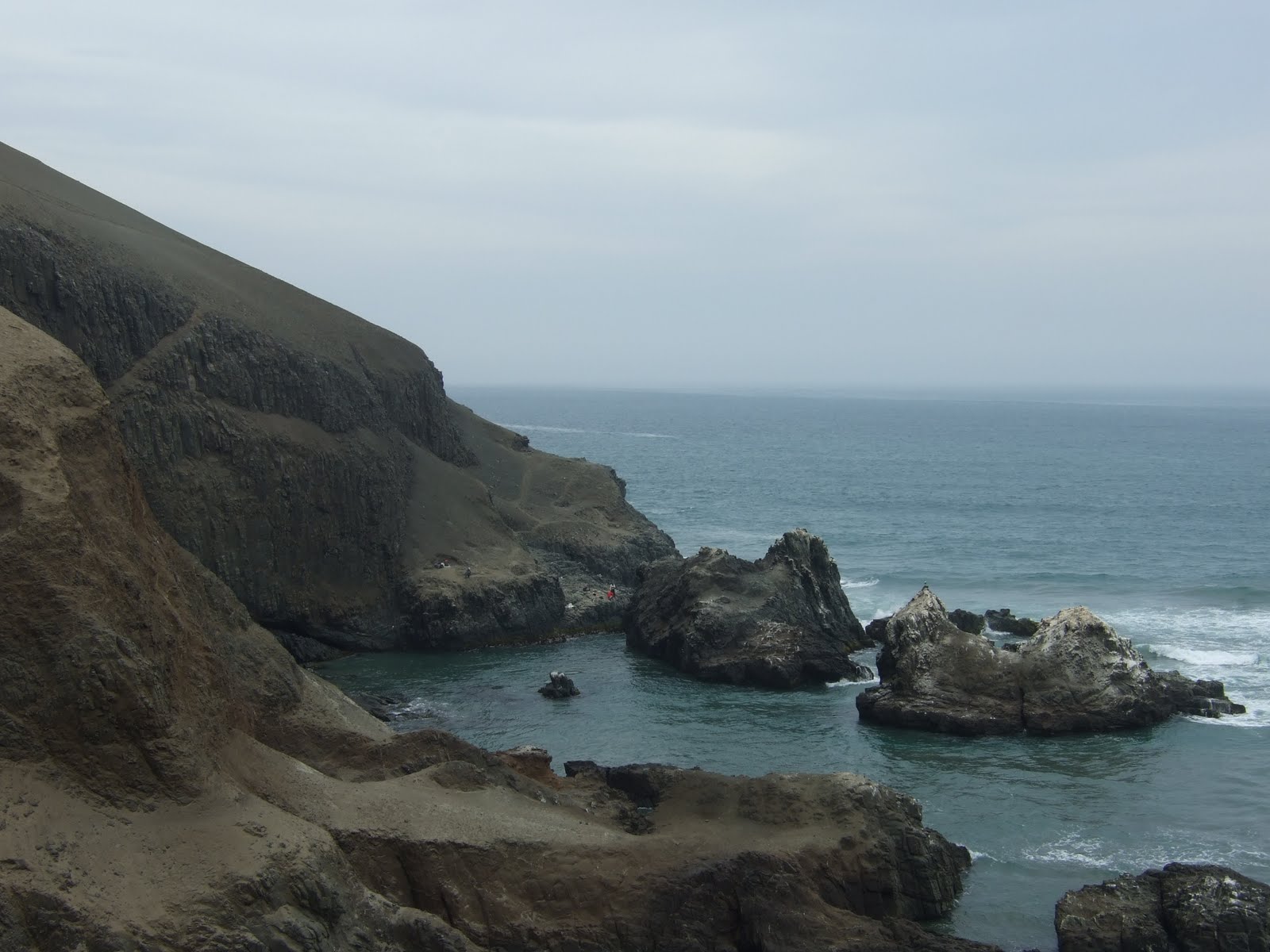
After another long drive through yet some more peruvian desert coastline we stopped to camp at a really pretty coastal bay named Puerto Inca overlooked by a small ruins. noe further south along the Peruvian coast we really noticed the difference. The sea was rough with strong currents so not swimmable and the water cold. I took a beautiful walk uphill to the ruins looking across the bay and watching the sunset, and enjoying some time out by myself in the rugged landscape which had been home to the inca´s many years before. Again, the photo´s hopefully interpret some of the beauty of the place.

Friday, 7 January 2011

A fabulous start to the next leg of the Dragoman trip!


Ok, I know I was meant to only go to Lima with the Dragoman tour but I was enjoying the company and felt I was going to see a lot more of Peru with the tour rather than travelling on my own. I knew it was the correct decision on day 2 of the tour. From Lima we continued our journey along the desert coast of Peru. We stopped off at an odd little touristy town which was nothing special but a place to get a boat trip across to the Ballestas Islands, otherwise known as ´The Poor Man´s Galapagos´. The speed boat was fast and the waves rough in places but the 45 minute trip to the islands were worth it. Once there the driver slowly navigated around the islands for many photo opportunities of the sea lions, penguins and other bird colonies. We adjusted to the offensive smell of feaces on the rocks which we later found out is harvested every 5 years for use as a fertilizer overseas and generates a good income apparently. I feel sorry for the guys who have to do the harvesting!
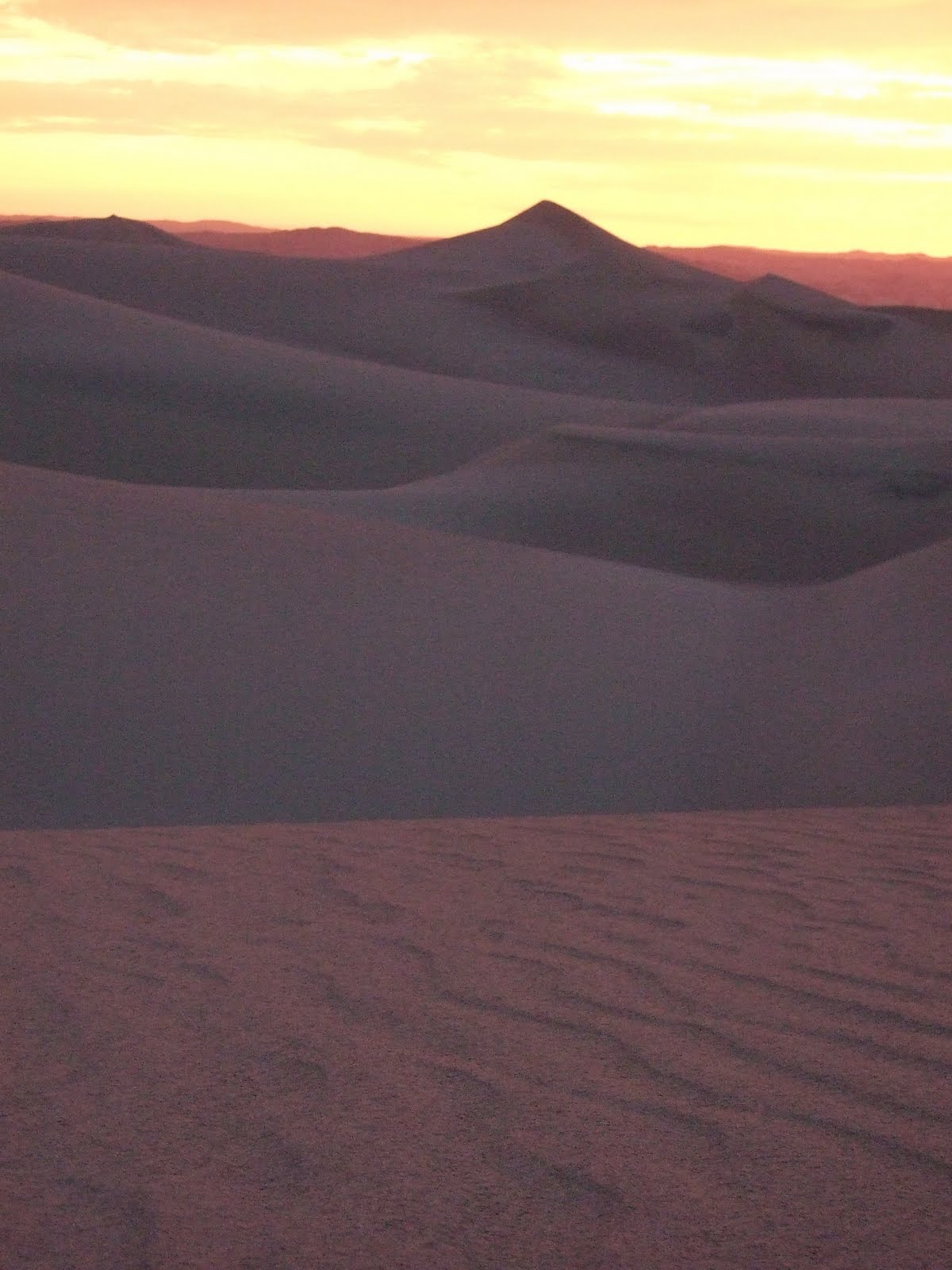
After a good seafood lunch on the coast and entertainment from a local musician and the waitress dancing, we drove on to Huacachina for activities in the sand dunes! We all hopped in to a sand buggy which had an 8 cylinder Chevrolet engine (for you car geeks out there) and each taking approximately 8 passengers plus the driver. Our lives were in the hands of our driver for the next few hours as we sped across the dunes for a thrilling sandy heltor sceltor ride in the very noisy and powerful bits of metal with roll cages. With clothing strapped round our heads to keep the sand out of our facial orifices, our cheeks ere pinned to our ears down the hills and our eyes fell on to our laps and hearts to our stomachs as we realised the next descent and the speed in which we were travelling! The desert air was filled with screams which even over powered the sound of the air as we pushed through it and the engine of the sand buggy!
Every now we would stop at the top of a sand dune to lay down on what was effectively a piece of ply wood prewaxed on the smooth side and we would throw ourselves off the top of the dune headfirst for some more adrenalin action. This was great fun to be honest, highly entertaining and there is so much dune that you know you will eventually come to a natural stop. You just have to enjoy the ride and wherever it takes you and keep your arms on the board to avoid serious sand burns!
After all the adrenaline and action we witnessed a beautiful sunset and then had a BBQ and far too many pisco sours in the sand dunes! With music playing, the warm desert air, pisco flowing freely I decided it was time to bust out some moves in the sand. Yes I have now officially woop wooped in the desert now. I have to admit it is quite difficult on the soft going but at least I wasn´t at risk of shin splints again! Eventually I crawled into my sleeping bag which was laid out on the sand and slept for what was left of the night under the stars of the Peruvian dessert.
Great day, great food, great people, great memories x

Saturday, 1 January 2011

More photos


Huanchaco itself is a funny little seaside town. The picture taken through my sunglasses shows the traditional boats which apparently now are stuffed with polystyrene!

Looks like Herby(the VW) didn`t make it past Peru and Haunchaco have gone up in the world now and they all drive lamborgini's!! (ok it is a make of icecream and this is an icecream bycicle).

As we passed through a major town on our way to Lima and due to diversions and heavy traffic I managed to get some good footage. Note how traditional vehicles are still in use amongst all the modern day cars and lorries. Note also the young boy on the back of the lorry.

Note how Pepsi adverts can even be found in the middle of the desert, just to keep the drivers alert to avoid going over the edges!

I am sure you will agree though, there is also some stunning coastline in Peru, note though how wild it is in comparison to pictures shown in earlier blogs from Northern Peru.

We finally get to Lima, a colonial city and the capital of Peru after an epic days drive. I shall not say much about Lima apart from I learnt a valuable lesson when I got a little bit tipsy and fell for a local scam! Along with all those Pisco Sours I did try Alpaka which is very tasty. Lima was meant to be where I finished by Dragoman tour but I had enjoyed the people and the tour so much I decided to stay on for another 2.5 weeks so I could see as much of Peru as possible.

I almost forgot to mention, Latin America so far seems obsessed with horns and they use them for all sorts of reasons and occasions, so much so that in Lima they have made specific silencio signs to stop the noise in certain areas, needless to say the signs do not make a bit of difference! It is funny though and just adds to the chaotic and lively feel of the city.


Saturday, 11 December 2010

Huanchaco and Chan Chan


The drive to Huanchaco near Trujillo was a long 12 hours but blessed us with some amazing scenery. We got stopped several times by police on route, just carrying out routine checks on the Pan American Highway. To be honest I think half of the reason they stop people is to relieve their boredomn or top up on supplies of toilet paper. They sit on the edge of the highway in the middle of nowhere in the heat of the desert for hours on end with one colleague for company and some cheesy dance tunes playing on the radio. One pair boarded the truck, had a look around, had a chat with us then grabbed some loo roll on the way out! It really was quite entertaining.
For the most part we travelled through desert. We passed the odd house / wooden shack made of timber with maybe a horse / mule, chickens, and a few cattle in the backyard grazing on what little vegetation there was. It must be quite a hard life with very little / no fresh running water and so far to the nearest town to get supplies. I also couldnt help noticing the amount of litter in the desert. It looked like it had blown across the land until lodging itself in the odd shrub. Further into the drive I realised that it is common to see waste just dumped along the roadside in the desert and often loads of it! I dont know whether there are any official sites for waste diposal in the desert which admittedly is vast with very little in the way of habitation but I would assume not. This is not the case in the peruvian cities as there are facilities for recycling etc.
On the occasion we passed a fresh water source on route to the sea we saw a green oasis of very organised agricultural plots. Again the houses were basic and horses / mules were being used for farming and sheep, cattle and chickens were being farmed.

When we did drive through a town it was a strange cacophony of trucks, tuk tuks and mules or pedestrains pulling loaded carts all trying to manouvre around each other on a fairly narrow road.

On route we stopped for a welcome break from the drive and a short visit to Sipan Museum and our introduction to the interesting and fasinating cultural history of Peru and it`s inhabitabts. The Museum displays many artefacts found in the world famous burial chambers underneath adobe pyramids. The 13 skeletons found pre dating the inka's and were buried with ceramics, ellaborate metal work of gold and silver made into jewellery for the whole body. This was a good introduction to the Moche civilisation. Unfortunately no photography was allowed in the museum so I do not have pictures to share. For the final part of our long journey to our campsite in Huanchaco we watched a beautiful sunset across the desert.

The following day we visited Chan Chan, ruins in the Peruvian desert near Trujillo on the coast. Predating the inka's the ruins are were the capital of the kingdom of the Chimu Empire and the site probably used for rituals, fiestas and trading. It is a maze of large rooms and squares with the remanents of incredible artistry and decor on the thick walls which in their day must have been fantastic, of which the pictures have provided a lot of information about the lives of the people at the time. On the coast fish was a amin foodsource but they also were good agriculturists. Although they worshiped the sun and the moon as gods and made temples for each, the moon was their god (probably because it gave them relief from the hot and dry daytime) and we were able to visit the Huaca de Lunes, A huge ruined temple where sacrifices to the god would have been made. The most fascinating part is that it comprises of several overlapping temples as each time a king died the Chimu's would fill in that layer and rebuild the temple on top of the previous one with large colourful murals each time which the remains of can still be seen.

By the time the inka's conquered the Chimu's in 1470 AD the empire strectched 621 miles of the pacific coast.